£4,000 a Quarter, Every Quarter: The Long-Term Cost of SaaS

A software bill of around £4,000 a quarter can become routine surprisingly quickly. It is approved, paid and absorbed into the cost of running the business. Then the next quarter arrives.
Over five years, that is £80,000. Over ten years, it is £160,000, even if the price never rises.
That is the scale of spending I have in mind when I question how businesses approach software. A decision at the company I work for to use HubSpot prompted the thought: what could a business build and own if it treated years of subscription payments as a potential investment budget?
I am using approximately £4,000 a quarter as the example here, rather than claiming it is a standard HubSpot price or publishing a verified breakdown of my employer's contract. The wider point applies to any recurring service with similar costs.
Tools such as OpenAI Codex and Claude Code make this question more interesting. If AI reduces the work required to build a focused application, a business may have a credible way to replace a continuing subscription with software designed around its own requirements.
The opportunity is to redirect some of that long-term spending into something the business controls. The comparison needs to include what it costs to keep that software running, but it should begin with the full lifetime of the subscription.
What does £4,000 a quarter become over time?
At a constant price, the subscription alone adds up to:
- One year: £16,000.
- Three years: £48,000.
- Five years: £80,000.
- Ten years: £160,000.
Those figures involve no growth in users, no upgrades and no price increases. They are simply the same quarterly payment repeated. Additional implementation, integration or administration costs would sit on top where they apply.
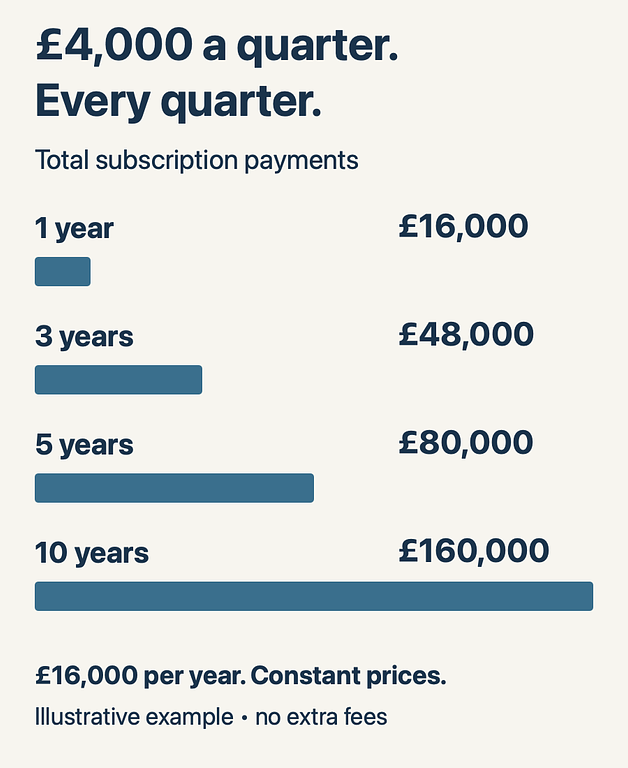
Arithmetic illustration based on approximately £4,000 per quarter, held constant. These are nominal subscription payments, with no assumed price rises or additional charges.
A business considering a £30,000 custom application might regard it as a major investment. Yet a £4,000 quarterly subscription passes that amount during its eighth quarter. The two commitments can receive very different scrutiny because one is presented as a project and the other arrives as a familiar operating expense.
That does not mean the subscription provides no value. It provides an ongoing service, and the business may also create valuable customer records and processes while using it. What the subscription generally does not purchase is ownership of the underlying application or control over its future pricing.
The question is whether the continuing value of that service justifies the continuing cost when an owned alternative becomes feasible.
What are businesses really paying for?
A software subscription buys more than access to screens and a database. It can provide hosting, updates, support, integrations and a team responsible for keeping the product working. Those are valuable services.
But the invoice is only part of the cost.
There is also implementation, administration, integration work and training. There may be additional charges as users, features or consumption increase. A platform that needs extensive configuration can become a continuing project of its own.
Then there is the less visible cost of poor fit. Staff enter the same information twice. A spreadsheet fills a gap between departments. An approval happens in email because the system cannot represent it conveniently. Someone spends Friday afternoon assembling a report the business needs every Monday.
These are examples to look for, rather than claims about any particular product or my employer. The useful question is: how much does the complete workflow cost, including the work people do around the software?
A cheaper licence can still support an expensive process. A more expensive platform can be excellent value if it removes enough work.
Why does AI change the calculation?
The interesting development is the ability to delegate substantial development tasks, then inspect and improve the result. Writing the first version of a feature becomes one step in a cycle of specification, implementation, testing and review.
In a February 2026 account, OpenAI described building an internal beta with Codex generating the code, tests, deployment configuration and supporting material. Its team estimated that the work took roughly a tenth of the time that manual coding would have required. Human engineers still designed the working environment and feedback loops. This is a vendor's account of a particular experiment, not an independently established tenfold saving for ordinary business projects. Read OpenAI's engineering account.
Anthropic's Ramp case study offers another useful example. Ramp reported that internal tooling built with Claude Code helped reduce incident investigation time by up to 80%. That concerns a particular operational activity; it does not mean all engineering became 80% faster. Even with that limitation, it illustrates the opportunity to create tools around a company's specific problems. Read the Ramp case study.
My interpretation is that more previously marginal projects may become affordable. A specialist dashboard, approval process or internal application might justify investment at a lower development cost, even when it never justified a traditional software project.
Businesses should test that possibility with their own work.
What does the independent evidence say?
The evidence also calls for restraint. METR's early-2025 experiment found that experienced open-source developers working in familiar repositories took 19% longer with the AI tools tested. In February 2026, METR said its subsequent experiment could not reliably establish the current effect: participant selection and measuring work across concurrent agents complicated the results. It thought improvements were likely, while emphasising weak evidence about their size. Read METR's update and discussion of the earlier study.
That is a useful warning against buying a promised productivity multiplier.
A demonstration can show that an agent produces an application quickly. Your pilot needs to show that the application solves the right problem, behaves correctly, survives real use and can be maintained economically.
Measure the time to an accepted, working change. Include the time spent correcting the output. A large volume of generated code is not a business outcome.
Do you need to rebuild HubSpot?
Usually, that would be the wrong scope for the first project.
A mature CRM platform serves many businesses and supports a broad collection of functions. Recreating its entire feature set would be a very different undertaking from building the application one business actually needs.
Consider an illustrative specialist services company. Its customer journey might be:
- Capture an enquiry and assign an owner.
- Arrange a site assessment.
- Prepare a quote using agreed pricing rules.
- Obtain technical and commercial approval.
- Hand the signed job to delivery.
- Track progress, handover and renewal opportunities.
A tailored application could organise itself around those steps, with the right documents, responsibilities and permissions at each stage. It could give each team a focused view and generate the particular reports management uses.
That is a credible product boundary. “Build our own HubSpot” is much less useful as a specification.
The existing CRM might still be the right home for contacts and communications. A custom application could sit alongside it, handling the specialist workflow and exchanging data through supported integrations.
The most attractive opportunity may be the layer between standard software and the way your business operates.
How much could the business afford to invest instead?
Start with the £16,000 annual subscription and work backwards. How much would an owned application cost to operate, maintain and improve each year? The difference is the annual amount available to recover the initial investment.
For illustration, suppose a narrowly scoped application costs £30,000 to design, build, migrate and introduce, with £6,000 a year for hosting, backups, monitoring, development tools, maintenance and support combined.
These custom-software figures are hypothetical planning assumptions, not a quote or evidence that a suitable CRM can be delivered at that price. The £6,000 allowance would require a modest application and limited support needs. It must include the cost of staff time, even when an employee does the work.
Under those assumptions:
- After one year: subscription payments total £16,000; the custom application totals £36,000 including its initial build.
- After three years: subscriptions total £48,000; the custom application also totals £48,000.
- After five years: subscriptions total £80,000; the custom application totals £60,000.
- After ten years: subscriptions total £160,000; the custom application totals £90,000.
The custom option starts out more expensive. Its benefit accumulates over time because the annual operating cost is £10,000 lower. In this simplified example, the original investment is recovered after three years of operation. By year five, the difference is £20,000; by year ten, it is £70,000.
The ten-year figure assumes the application remains useful without a major rebuild and that all prices remain unchanged. It is a scenario to examine, not a forecast. Build time, overlapping subscriptions during migration, major upgrades, tax and the time value of money are excluded. Those belong in a real investment appraisal. Existing SaaS implementation spending is a sunk cost when deciding what to do next.
The maintenance budget determines whether it works
If annual ownership costs reach £12,000 instead of £6,000, the annual saving falls to £4,000. A £30,000 initial investment then takes 7.5 years of operation to recover, before transition costs. If the annual ownership cost reaches £16,000, there is no recurring cost saving to repay the build at all.
That gives the business a concrete requirement: a replacement needs an affordable operating model as well as an affordable build.
It also puts the ambition in perspective. At this level of subscription spending, a large bespoke software team is unlikely to be justified by licence savings alone. The opportunity depends on a focused application, restrained scope and economical maintenance.
What if the subscription price rises?
As a separate sensitivity example, if the £16,000 annual subscription rose by 5% each year from year two, payments would total about £88,410 over five years and £201,246 over ten. This is a hypothetical increase, not a prediction about HubSpot's pricing. Custom hosting and labour costs can rise too, so a proper comparison should test both sides.
Procurement needs the actual renewal terms and a current quote. HubSpot's flexible seats-and-credits migration FAQ describes a model involving editions, seats and usage credits. Your package and usage determine what belongs in the calculation. Read HubSpot's pricing migration FAQ.
Why do repeated renewals deserve more scrutiny?
A subscription can feel reversible because the business pays periodically. In practice, leaving can become harder as teams rely on the system, integrations accumulate and historical data builds up.
That creates a useful reason to evaluate alternatives before the next renewal deadline. A business needs enough time to understand its data, test a replacement and plan a safe migration. Waiting until the contract is almost due can leave renewal as the only realistic option.
The investment question also extends beyond one application. A business with several subscriptions should map what each one does, where capabilities overlap and which workflows might share a smaller internal system. Add up the actual bills before deciding where to start.
An extension to an existing CRM may improve efficiency, but it only reduces subscription spending if it lets the business remove paid features, reduce the bill or eventually retire the service. Otherwise, its financial case must come from the operational value it adds.
Where does owning the software create value?
Direct savings are only one part of the case.
Changes can follow the business
A new approval rule, reporting requirement or service line can become a change to your own product. You still need to prioritise and pay for the work, but you can decide whether it matters enough to do now.
That flexibility is valuable when software supports a process that changes frequently or differentiates the business.
The workflow can become simpler
A focused application can show employees the information and actions relevant to their role. Fewer screens and less duplicate entry may matter more than adding another feature.
Measure that value. Time a representative task before and after the change. Track errors, rework and adoption. An application that looks elegant but sends people back to spreadsheets has not solved the problem.
Knowledge can stay with the company
Explicit rules, documented data models and tested workflows can capture knowledge that previously lived in someone's inbox or memory.
Ownership needs practical foundations: access to the repository, deployable backups, documentation and people who understand the system. A company with source code that only one contractor can operate still has a dependency problem.
Growth can have different economics
A custom application's costs need not increase by a fixed licence fee for every additional employee. Hosting, support and external service usage still grow, sometimes sharply, but the shape of that growth may be better suited to the business.
Model it at realistic user counts and transaction volumes. Avoid assuming that either subscriptions or infrastructure stay flat forever.
Does AI-built software need AI to run?
An agent can help build an ordinary application with forms, a database, permissions and deterministic business rules. The finished system may have no language model in its everyday workflow.
That distinction matters for budgeting and reliability. AI used during development is a different cost from AI invoked every time an employee processes a customer request.
If the application also uses models at runtime—for example to summarise notes or suggest responses—budget for that usage separately. Define what happens when the model is unavailable or produces an unsuitable answer. Keep consequential actions subject to appropriate checks.
Choose AI features because they improve a task. A straightforward approval rule often belongs in ordinary application logic.
What responsibilities come with building?
A business that owns software also owns the decisions about operating it, even when a supplier performs the work.
Before replacing a working system, establish who is responsible for permissions, security updates, monitoring, backups and recovery. Test restoration rather than assuming a backup file is sufficient. Agree how incidents are handled and what happens when the original developer leaves.
AI-assisted development makes review particularly important. Fast implementation can accelerate a misunderstanding just as easily as a correct requirement. Critical workflows need acceptance tests based on the business outcome, plus technical checks appropriate to the risks.
In my own publishing workflow, connecting an AI assistant to Funcoder involved more than getting an API call to succeed. File permissions, a separate revocable key and limiting that key to blog operations all needed attention. Even a small integration brings responsibilities beyond the visible feature.
For a CRM, those responsibilities grow with the sensitivity of the information and the impact of mistakes. An attractive prototype is the beginning of that work.
When should a business buy, build or combine the two?
- A standard need with a good, affordable product: buy and keep configuration simple.
- A distinctive workflow with measurable friction: evaluate a focused custom application.
- A useful existing platform with one important gap: build an extension or integration.
- No clear owner or maintenance budget: buy, or first establish that operating capability.
- Specialist obligations or high operational consequences: use proven services and qualified review; assess any custom component carefully.
- A large subscription with low usage and extensive workarounds: compare renewal, consolidation and a scoped replacement.
I would be particularly cautious about starting with payroll, payment processing or identity infrastructure. Established services can remain the foundation while your own application handles the workflow around them.
There is also a process question to settle first: is the unusual workflow genuinely valuable? Sometimes standardising how the business works is a better investment than automating every historical exception.
What should a practical first project look like?
Treat the first project as a controlled business experiment. A 90-day pilot is a useful planning frame for a sufficiently small workflow, rather than a promise that every application can be delivered in three months.
Weeks 1–2: establish the problem and baseline
Choose one workflow with clear users and a measurable cost. Record the steps, exceptions, time spent, error rate and existing software costs. Identify the person who can make decisions about the process.
Write down success criteria before development starts. For example: reduce duplicate entry, shorten a particular approval cycle and produce a specified report without manual assembly.
Weeks 3–4: prototype and test the fit
Use synthetic or appropriately controlled data. Put the prototype in front of the people who will use it. Check awkward cases as well as the ideal path.
Use what you learn to refine the scope and cost estimate. Stop if the problem is better solved by configuring an existing product.
Weeks 5–8: prepare it for real use
Implement and test permissions, validation, logging and recovery. Rehearse migration. Document deployment and routine operation. Obtain technical review appropriate to the data and business risk.
Keep the first release focused. Every extra feature adds work to test and maintain.
Weeks 9–12: run a limited pilot and decide
Introduce it to a small group with a rollback plan. Compare actual results with the baseline. Count support requests, maintenance effort and external service charges as well as development time.
Make the decision to expand, revise or stop using evidence. Cancel the old subscription only when migration, acceptance and contractual timing make that sensible.
How should the budget change?
The investment is broader than purchasing Codex or Claude subscriptions. It includes time from people who understand the business, engineering judgment and a continuing maintenance allowance.
A practical model is a business owner who defines priorities, an engineer or accountable development partner who owns technical quality, and domain experts who test real scenarios. AI can support their work throughout the cycle.
Ask for an application the business can operate and change. Include source access, documentation, data export and handover in the deliverables. Evaluate dependency on cloud providers, model providers and individual developers alongside dependency on a SaaS vendor.
Software ownership should give the business more options in practice.
The next renewal deserves a different conversation
At £4,000 a quarter, a business is already making a substantial commitment to software. Five years of payments is £80,000. Ten years is £160,000 at an unchanged price.
My argument is that businesses should examine what a portion of that commitment could fund if it were directed towards an application they own. Codex and Claude make that a question worth testing, particularly where the required workflow is much smaller than the platform being purchased.
There will still be costs: someone must maintain the software, support users and keep it secure. Ownership earns its place when those costs leave a meaningful long-term advantage and the application fits the business better.
Before the next renewal, put the five-year subscription total beside a realistic build-and-operate proposal. Compare the required outcomes, migration costs and continuing responsibilities. Run a small pilot where the numbers justify it.
A quarterly software bill is also a long-term investment decision. Businesses should start treating it that way.
Research checked 19 November 2026. This article combines personal opinion, linked research and an explicitly hypothetical financial model. Vendor case studies describe individual experiences and do not establish typical savings.